

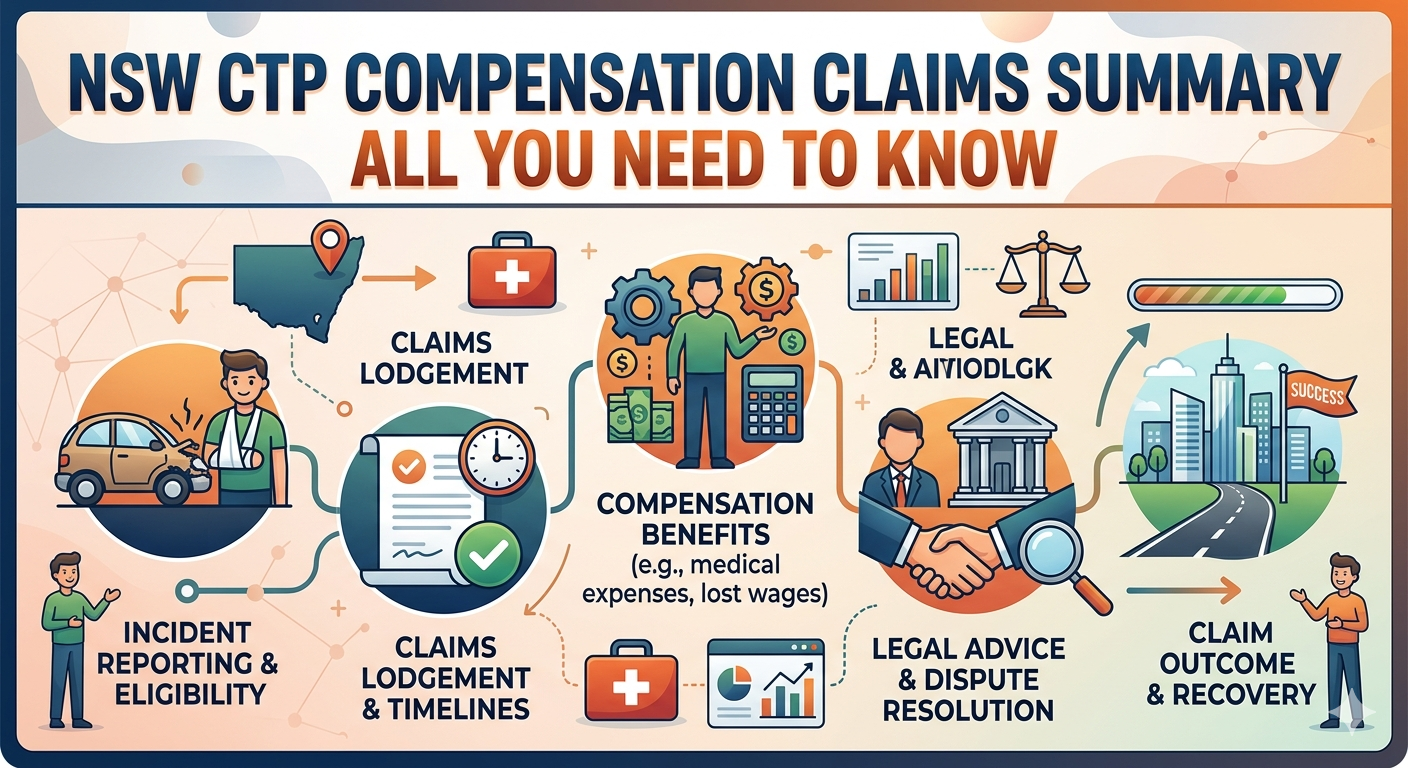
NSW CTP Compensation Claims Summary – All You Need To Know
Summary – Quick Breakdown
In New South Wales (NSW), if you or a passenger are injured in a not-at-fault car accident, you can claim compensation under the state’s Compulsory Third Party (CTP) insurance scheme. This is a fault-based personal injury scheme regulated by the Motor Accident Injuries Act 2017. Passengers injured in a crash caused by another driver can pursue statutory benefits and, in serious cases, common law compensation — including non-economic loss (pain and suffering) — provided the injuries exceed a permanent impairment threshold. Acting quickly, documenting injuries thoroughly, and seeking advice from experienced CTP solicitors such as PK Simpson Compensation Lawyers can maximimise your payout and speed up settlement. Common serious injuries include fractures, spinal and brain injuries, and psychological trauma, each of which can have long-term impacts on quality of life.
Read on for more detail
What Is a Not-at-Fault Car Accident in NSW?
In NSW, a not-at-fault car accident is one where you or your passengers were injured due to another driver’s negligence or wrongful actions — whether that was a rear-ender, a side-impact, a failure to give way, or another breach of road rules. If your injuries were caused by the fault of another vehicle’s driver, you are generally entitled to CTP compensation from that vehicle’s insurer.
Passengers in a vehicle are treated as injured parties under the CTP scheme, regardless of whether the driver of the car in which they were travelling was at fault. This means passengers can pursue statutory benefits and, in appropriate cases, common law damages.
Understanding NSW CTP Legislation
What Is CTP Insurance?
NSW drivers must purchase Compulsory Third Party (CTP) insurance — commonly known as a green slip — when they register their vehicles. CTP insurance covers personal injuries (including physical and psychological) suffered by people injured in crashes involving that vehicle. It does not cover property damage; that is dealt with under other types of insurance.
Who Can Claim?
Passengers injured in a not-at-fault car accident can claim CTP benefits if:
- The accident occurred in NSW*;
- Another driver was *wholly or mostly at fault; and
- You have lodged your claim within the required time limits.
(If a NSW registered vehicle crashes interstate, CTP cover depends on the law where the accident occurred.)
Types of CTP Benefits
NSW CTP benefits include:
- Statutory Benefits (Available Early)
Statutory benefits compensate for reasonable and necessary:
- Medical treatment and rehabilitation costs;
- Weekly loss of earnings;
- Domestic services, attendant care, and household assistance.
These are generally available regardless of fault early on after the accident.
- Lump Sum Damages (Common Law Compensation)
If your injuries are more than minor, and you were not at fault, you may pursue common law damages, which can include:
- Economic loss: Lost wages and reduced future earning capacity;
- Non-economic loss: Compensation for pain, suffering, loss of quality of life, loss of enjoyment, emotional distress, disfigurement, and long-term impacts on lifestyle.
To claim non-economic loss, you generally must have a whole-person permanent impairment greater than 10%.
Time Limits for Making Claims
Timing is critical:
- Early ANF claim: Up to $5,000 for treatment and lost earnings can be claimed soon after the crash via an Accident Notification Form.
- Statutory benefits: Generally must be lodged within three months of the accident to avoid loss of entitlement.
- Common law damages: Must generally be lodged within three years of the accident.
- Claims for damages often cannot be finalised until certain medical milestones (such as impairment assessments) have been reached.
Common Serious Injuries to Passengers in NSW Car Crashes
Car accidents can produce a wide range of injuries, but some are particularly serious and often lead to significant compensation claims:
- Orthopaedic Injuries
- Fractures (arms, legs, ribs, pelvis);
- Dislocations;
- Severe joint damage;
- Soft tissue injuries beyond minor sprains;
- Spinal Injuries
- Bulging or herniated discs;
- Nerve damage;
- Spinal cord injury leading to partial or full paralysis;
- Head & Brain Injuries
- Concussions or more severe traumatic brain injuries (TBIs);
- Cognitive impairment;
- Memory loss and behavioural changes;
- Internal Organ Damage
- Internal bleeding;
- Damage to lungs, liver, kidneys or spleen;
- Psychological & Psychiatric Injuries
- Acute stress disorder;
- Post-traumatic stress disorder (PTSD);
- Depression, anxiety and panic disorders;
- Long-Term Disability
- Amputations;
- Chronic pain syndromes;
- Loss of physical function;
These injuries can lead to ongoing medical needs, changes in employment capability, and significant impacts on quality of life — all of which factor into compensation amounts.
What Is Non-Economic Loss (Pain & Suffering)?
Non-economic loss : This refers to compensation for intangible harms — such as pain, emotional distress, loss of pleasure in everyday activities, scarring, and loss of enjoyment of life. It is commonly called general damages.
Unlike economic loss, which can be measured by lost income, non-economic loss is assessed by:
- Severity and permanence of injury;
- Degree of impairment (often measured by a whole-person impairment assessment);
- Medical evidence and expert reports.
In NSW, non-economic loss is generally only payable where an assessment shows the injured person has more than 10% whole-person impairment as a result of the accident.
Maximising Your Payout After a NSW Car Accident
- Seek Immediate Medical Treatment
Prompt diagnosis and treatment not only improves recovery but also strengthens your compensation claim if ongoing issues persist.
- Keep Comprehensive Records
Document everything:
- Medical reports and progress notes;
- Police reports;
- Receipts for medical costs and out-of-pocket expenses;
- Income evidence (pay slips, tax returns).
These records help establish both economic and non-economic loss.
- Lodge Claims Quickly
Making your statutory benefits claim and any subsequent lump sum claim within statutory timeframes preserves your entitlement.
- Undergo Impairment Assessments
Early impairment assessments are critical to demonstrate permanent impairment and qualify for non-economic loss.
- Work with Experienced CTP Lawyers
CTP compensation law is complex. Engaging solicitors who specialise in CTP and personal injury — such as PK Simpson Compensation Lawyers — can greatly influence outcomes.
Experienced CTP solicitors will:
- Identify all compensation heads you’re eligible for;
- Negotiate with insurers on your behalf;
- Prepare and present legal arguments to maximise your payout;
- Ensure correct assessment of impairment and damages.
Law firms that focus specifically on CTP law understand how insurers operate and what evidence is required to prove fault, liability, and quantify losses — especially for serious injuries. This expertise often leads to higher settlements and greater prospects of success.
Typical Stages to Settlement
A CTP claim generally follows this path:
- Accident and medical treatment;
- Lodge statutory benefits claim;
- Medical and impairment assessments;
- Lodge common law damages claim if eligible;
- Negotiate with CTP insurer;
- Settlement or potential court assessment.
Settlement timelines vary widely:
- Minor injuries: claims may settle in months;
- Complex injuries and serious impairment: settlements often take several years;
- Extensive claims may involve formal assessments or litigation if disputes arise.
Experienced CTP solicitors can often accelerate this process by preparing strong evidence packages early and managing insurer interactions effectively.
Why Legal Representation Matters
While you can self-represent, there are major advantages to working with lawyers experienced in CTP law:
✔ They know the Motor Accident Injuries Act 2017 and Regulations inside out;
✔ They identify lesser-known entitlements (e.g., attendant care, domestic assistance);
✔ They push for higher non-economic loss valuations based on injury severity;
✔ They manage submissions, negotiations, and, if needed, court proceedings;
✔ They can often achieve higher payouts with strategic claim handling.
This is particularly important for passengers, whose injuries may be serious but sometimes overlooked among liability questions or insurer tactics.
Conclusion
Not-at-fault car accidents in NSW can lead to substantial compensation claims for passengers — especially those with serious injuries.
Under the NSW CTP scheme, injured passengers can pursue:
- Statutory benefits (early treatment costs and income loss);
- Common law damages for economic loss and non-economic loss;
To qualify for non-economic loss, you generally must demonstrate a whole-person impairment of more than 10%.
To maximise your payout and navigate the complexities of CTP law, it’s vital to gather strong evidence, meet timeframes, undergo thorough medical assessments, and engage seasoned CTP advocates such as PK Simpson Compensation Lawyers who specialise in this area.
If you’ve been injured and aren’t sure where to start, consulting an experienced CTP solicitor early can protect your rights and ensure you pursue the full compensation you deserve.